

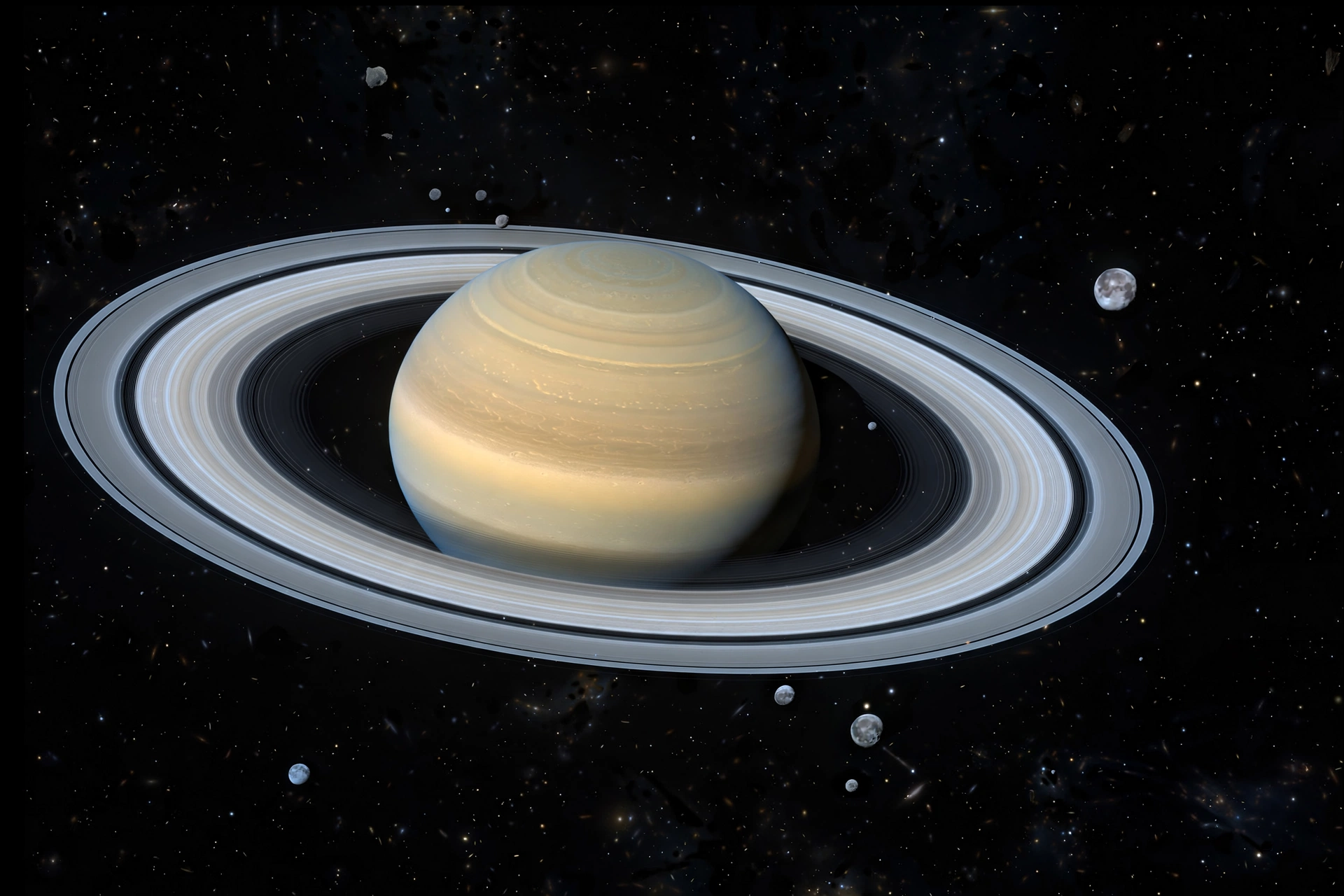
Look up Saturn in an older reference book and the moon count will be wrong. Astronomers have confirmed 128 more moons around the planet, taking the recognised total from 146 to 274. That is more than the combined total for every other planet, and it raises an obvious question for anyone reading the headline: what exactly did they find out there, circling a planet hundreds of millions of kilometres away?
Faint points that kept coming back
The discoveries came from deep images taken with the Canada-France-Hawaii Telescope on Mauna Kea over several years. The survey team, which included University of British Columbia researcher Dr Edward Ashton, searched for objects so faint that they barely register in a single exposure. Using a technique called shift and stack, they combined images while compensating for Saturn’s motion, letting real moons accumulate into visible points while background stars blurred away.
Finding a point was not enough. Each candidate had to be tracked until its orbit could be calculated and its association with Saturn established beyond reasonable doubt. Once that work was complete, the moons were recognised by the International Astronomical Union. Background on the telescope and its observing programmes is provided by the Canada-France-Hawaii Telescope, whose archive made the repeated measurements possible.
Not new worlds, but revealing fragments
The new moons are small, generally a few kilometres across, and they do not travel in the tidy, near-circular paths of Saturn’s famous inner moons. Their orbits are distant, tilted and frequently retrograde. In plain terms, many of them go the long way around, on slanted loops that look like leftovers from a messier era, because that is probably what they are.
Astronomers think larger moons were captured by Saturn’s gravity in the distant past and then broken apart by collisions. The pieces kept travelling together in loose families, slowly spreading along similar orbits. Seeing those families today is like arriving long after an accident and reconstructing it from the pattern of debris. Each fragment adds a point to the reconstruction and may help date the original breakup.
A different kind of space story
Seem News readers recently followed a far more immediate spectacle in our report on the SpaceX launch that created a jellyfish cloud on the East Coast. Nobody saw these moons with the naked eye, and no single photograph captures the announcement. The drama here is cumulative: hundreds of exposures, years of checking and a final tally that rewrites a familiar fact.
There is also a competitive footnote. Saturn and Jupiter have traded the moon-count lead in recent years as surveys improved, but a jump to 274 puts Saturn far in front. Closing a gap of this size would require a comparable haul around Jupiter, and there is no sign of one ready for confirmation.
Why the tally is worth caring about
Beyond the record, the enlarged catalogue helps scientists test ideas about how giant planets capture objects, how collisions redistribute material and how stable distant orbits can be over billions of years. It also sets a benchmark for future surveys, which will probe for still smaller and fainter bodies. Saturn at 274 is therefore both a result and a challenge. The planet has not changed; our ability to notice what has been travelling with it all along finally has.
Questions the new catalogue leaves open
A bigger catalogue creates new questions as quickly as it answers old ones. How many of the fragment families come from the same original collisions, and how many represent separate captures spread across Saturn’s history? Are there still larger undiscovered moons among the faintest groups, or is the remaining population almost entirely debris? And how does Saturn’s swarm compare with what a survey of equal depth would find around Uranus or Neptune, planets that have received far less attention of this kind?
Those questions are not rhetorical. They determine where telescope time goes next and which existing archives are worth reprocessing with newer software. A survey that produced 128 confirmations has demonstrated both a method and a yield, making it easier to argue for similar work elsewhere. The next announcement may be smaller, but the standard of proof established here will apply to it in full.
