

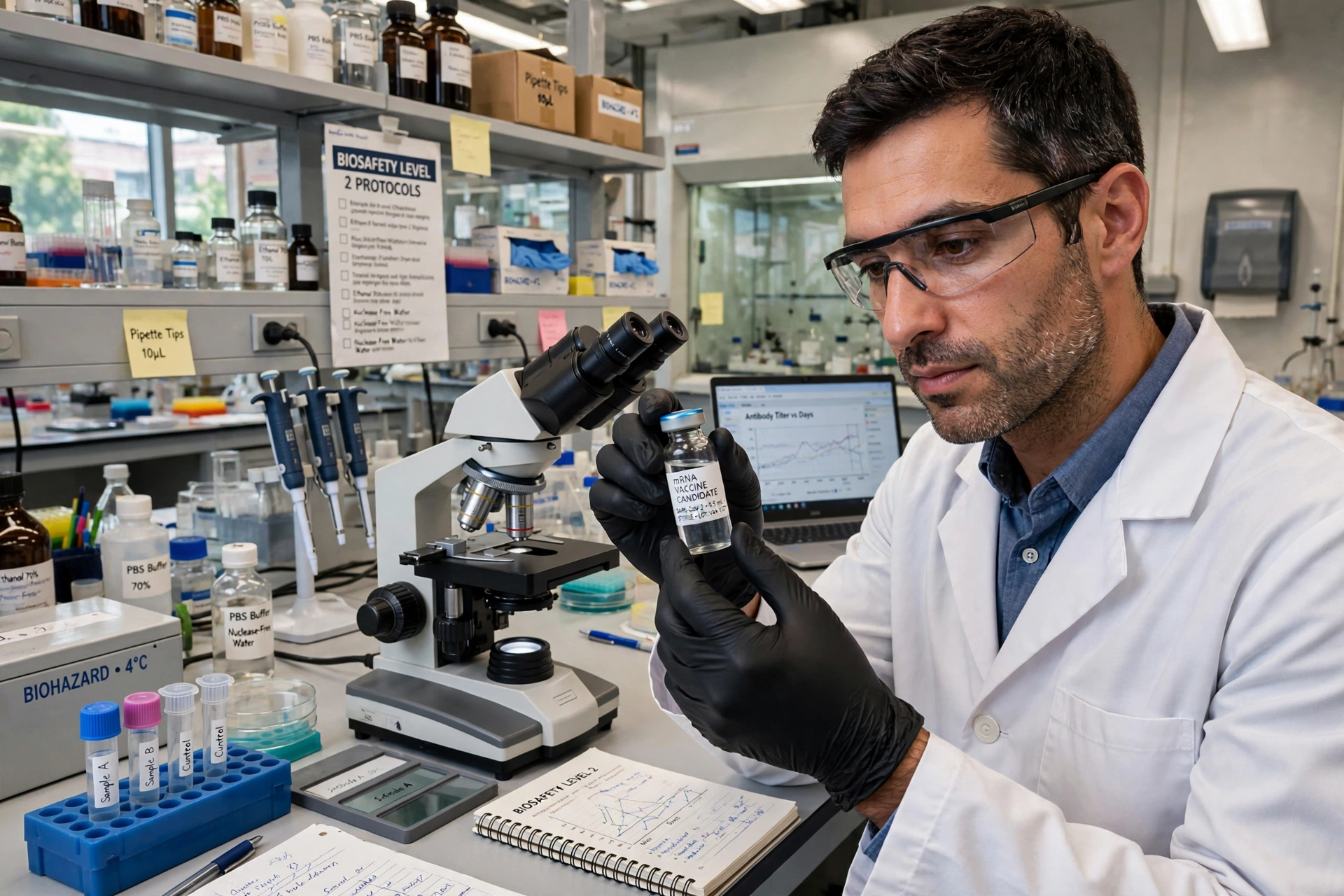
Most vaccines are identical for everyone who receives them. NeoVax is the opposite: each version is designed from the mutations in one person’s tumour. In a phase 1 trial in platinum-sensitive recurrent ovarian cancer, reported in Nature Medicine, NeoVax was combined with the immunotherapy nivolumab. The findings were early and carefully limited. The vaccines could be manufactured and given, safety was acceptable, and researchers saw immune responses. Nothing in the study proves the vaccine cures or controls cancer.
How a personal vaccine is supposed to work
When cancer cells mutate, they can produce abnormal protein fragments called neoantigens. Because those fragments differ from normal tissue, they offer the immune system a target that is, in theory, specific to the tumour. NeoVax is built to present selected neoantigens to the patient’s immune system, training T cells to recognise them. Nivolumab then blocks PD-1, a checkpoint that can hold T cells back, with the aim of letting a newly instructed response operate more freely.
General information about ovarian cancer and immunotherapy is available from the National Cancer Institute, and the study appeared in Nature Medicine. The patients involved had cancer that had returned after treatment but remained sensitive to platinum-based therapy, a specific situation that should not be generalised to all ovarian cancer cases.
The result was about possibility, not proof
Phase 1 trials exist to test whether a new approach can be used safely enough to keep studying. For NeoVax, that question included the entire personal supply chain. Could researchers obtain and analyse tumour material, identify suitable targets, manufacture a unique vaccine and administer it to the right patient together with nivolumab? Their answer was yes, the process was feasible in this trial setting. They also described the safety profile as acceptable and reported T-cell responses, which suggest the immune system noticed the targets it had been shown.
Those steps matter because personalised medicine often sounds easier in a headline than it is in a hospital. Every bespoke product is a scheduling and quality-control challenge. Demonstrating that the chain can be completed, repeatedly and for real patients, is the foundation any larger trial would need. It is still only a foundation.
Reading this alongside other health news
Context helps. Much of the health coverage people encounter, from infectious disease to screening, concerns interventions already tested in large populations. This trial belongs at the experimental end of the spectrum. Our audience arrives with varied interests, as our recent sports coverage of Maria Sakkari at the Wuhan Open and our space reporting both show, but the standard for a medical claim must stay strict regardless of how hopeful a story sounds.
What still has to be shown
Larger studies will need to determine whether adding a personalised vaccine to checkpoint therapy changes outcomes for patients, which patients benefit most, and whether the manufacturing model can be delivered affordably and on time outside a small trial. Researchers will also watch for longer-term safety and for evidence that immune responses correspond to meaningful clinical effects. Until then, the fairest summary is also the most accurate: NeoVax plus nivolumab was feasible to deliver in an early ovarian cancer trial, its safety was acceptable in that setting, and immune responses were seen. Promising enough to continue is not the same as proven, and the researchers’ own framing keeps that line clear.
How to talk about this study accurately
Friends and family members often ask whether a report like this means a new treatment is close. The accurate answer is that it means a new treatment idea has survived an early test that many ideas fail. The vaccine could be made for real patients, it could be given with an existing immunotherapy drug, its safety was acceptable in that small setting, and immune responses were detected. Each of those points removes one reason to stop. None of them removes the need for larger trials, and the timeline for those trials is measured in years, not weeks.
That may sound deflating, but it is how dependable medicine is built. Ovarian cancer research has seen promising early signals before, which is why the field insists on controlled evidence before changing practice. Readers who keep that framework in mind will be able to follow the NeoVax story as it develops without being misled by any single headline, including ours.
